

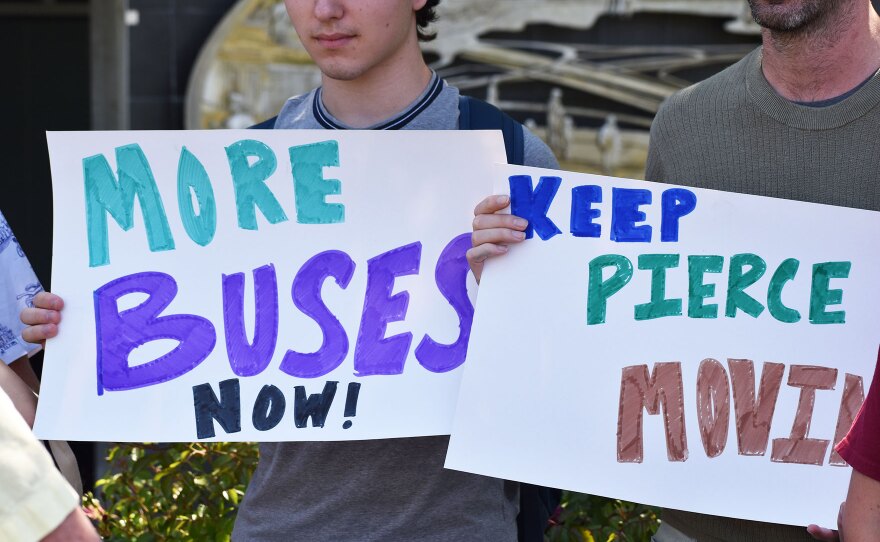
The Pierce Transit Board voted Monday to send a measure to the November ballot that would increase the amount people pay in sales tax for transit funding.
If voters approve the measure, the transit agency plans to use the funding to operate buses for longer hours, add special event service and make bus service more frequent, among other expanded offerings and improvements. New routes would be added to downtown, Northeast and East Tacoma, and a seasonal route would serve Ruston.
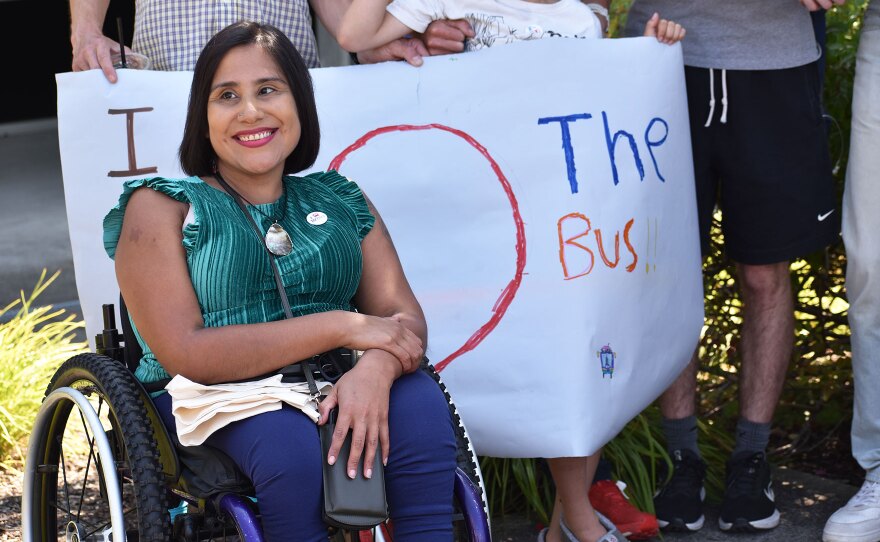
At a press conference outside the Pierce Transit Training Center before the board voted, Krystal Monteros said more frequent service would benefit people like her who use a wheelchair.
" I've experienced so many different challenges in the sense of being a wheelchair user. Everything — when it comes to how often the bus comes in, whether the bus is overcrowded with able-bodied people, and they just don't have room for a person with a disability," Monteros said.
The county's buses only have two spaces for people using a wheelchair, which can lead to long waits for multiple wheelchair users trying to ride the same bus.
" If the bus only goes every hour, two of us can only go. If those spaces are available, two of us can go. And then we literally have to wait another hour for the next two people just to go," Monteros said.
The funding would allow Pierce Transit to make buses arrive more frequently.
Chris Schuler, Pierce Transit's chief financial officer, said that the measure is expected to generate about $64 million in new revenue. It would increase the sales tax for transit from six cents on every $10 spent on qualifying purchases to nine cents on every $10 on those purchases. Items like groceries and gasoline are excluded from the tax.
The additional funding will also make sure that the transit agency doesn't have to use its reserves to continue existing service, as costs are projected to rise.
During the Pierce Transit Board meeting, Schuler explained what would happen for the entity if funding doesn't increase.
"We do currently have a healthy reserve balance. However, our reserves are largely committed to capital projects," Schuler said. "By 2032, reserves are projected to fall below our required minimums. So without additional funding, Pierce Transit would continue running the current level of service for as long as possible, but those rising costs will eventually need to be covered by cutting back service."
The last time Pierce Transit received a sales tax rate increase was 2002, which was also the last time the transit agency increased service.
" Pierce Transit is chronically underfunded compared to peer agencies, which means that the people of Pierce County are chronically underserved," said Laura Svancarek, executive director of Tacoma On the Go, a local nonprofit working on transportation and mobility issues.
According to the Municipal Research and Services Center, Jefferson Transit Authority, which serves Jefferson County, collects nine cents for every $10 through its sales tax. Spokane Transit collects eight cents for every $10 and Island Transit collects nine cents for every $10.
The Pierce County Central Labor Council endorsed the measure. Nathe Lawver, secretary-treasurer for the labor council, pointed to how reliable transit can be a more affordable option.
" Workers keep our communities running, and they deserve a transit system that they can count on," Lawver said. "Strong transit strengthens our workforce, supports local businesses and makes our communities more affordable and more connected."
If voters approve the measure, the transit entity would begin implementing changes in 2027, and these would be fully operational by 2032.
Read the audio transcript here.
Copyright 2026 NWPB News (Northwest Public Broadcasting)


