

It seemed like getting a whaling permit would be little more than a formality after federal regulators granted the Makah Tribe a waiver to revive its traditional hunt under the Marine Mammal Protection Act. For more than a year, the tribe’s permit application has gone unanswered. But the Makahs say they are doing what they can to get ready to hunt as soon as this summer.
This winter, they submitted a new request to amend their permit application so they could start the hunt this July, instead of waiting until 2027.
The permit application they submitted last March was for two hunting seasons, from July to October in 2025 and 2027. Federal regulators with the marine fisheries division of the National Oceanic and Atmospheric Administration put the application out for public comment. But the first hunting season passed without an official reply.
“It's been very frustrating,” said Christopher Martinez, chief of staff for the Makah Tribal Council and secretary of the Makah Whaling Commission.
He said the tribe has worked hard over the last 20 years to meticulously follow the letter of U.S. law. They have carefully complied with every bureaucratic detail, completing an environmental impact statement about the hunt and then applying for the waiver and permit under the Marine Mammal Protection Act.
“To still have a hold up, after doing everything on our part, is really infuriating to the tribe,” he said.
Ancient roots of Makah whaling
Southwest of town in Neah Bay, Daniel Greene stands in a grassy clearing on the edge of the Pacific Ocean. There is a reconstructed longhouse here, with a painting of a gray whale on its side.
Greene is from a Makah whaling family. He said this property is in one of the oldest of five original Makah villages, carbon dated at nearly 4,000 years old. It’s called Waatch Village, or in Makah language, WaɁač́.
“This is where my great-grandfather was born, in one of our longhouses,” Greene said. His name was Qʷa·ɫqʷi·bit.
Greene said this is where the most important Makah stories take place — stories of how whaling first began, like the one of a great famine and the Thunderbird that battled a whale and dropped it on the beach, providing the tribe with food, oil, and the knowledge to hunt.

Greene said from these bluffs, you can see whales migrating past every year “by the hundreds.” And whale bones are built into the foundations of the houses. He remembers clearing the land near a drainage area when he was a young man in his 20s.
“Just pulling sticker bushes out, you know, whale bones rolling out of the sticker bushes. Pretty darn cool!” Green said, laughing as he remembered that moment.
“They're heavy, dense bones. So they're really old, bigger whales,” he said. To Greene, that indicates that this is a tradition carried out by experienced whalers with a long history.
About 10 miles to the south is where the last whale was taken by the tribe, in a federally permitted hunt in 1999.
Greene trained with that last whaling crew. But he was just a teenager — too young to actually hunt — and the tribe, facing litigation from whaling opponents, was ordered by a three-judge federal appeals court panel to stop in 2002.
Now 44, with seven children, Greene said he might be too old. But he has been preparing physically and spiritually, along with others in the tribe who come from whaling families.
“To actually fill in that missing piece, to actually go out and do the hunt … [is] like the culmination of everything,” he said.
Greene is vice chair of the Makah Whaling Commission. He said they are hoping to resume the hunt in July. Other members of the commission who spoke to KNKX want the world to know: It’s time. They’re ready.
Makah Chief of Staff Martinez said crews are getting out on the water, actively training.
“They’re pulling in the canoe, and practicing and preparing for everything that they need to do,” he said. “I don't see any real challenge for the tribe and for the whalers, other than, you know, not being able to actually go hunt.”
The whaling commission members say the only obstacle is the permit approval.

Keeping the culture alive
Despite the fact that the tribe has only successfully hunted one whale in nearly a century, important whaling stories, songs and traditions are shared privately in families. Increasingly, they are also shared at school.
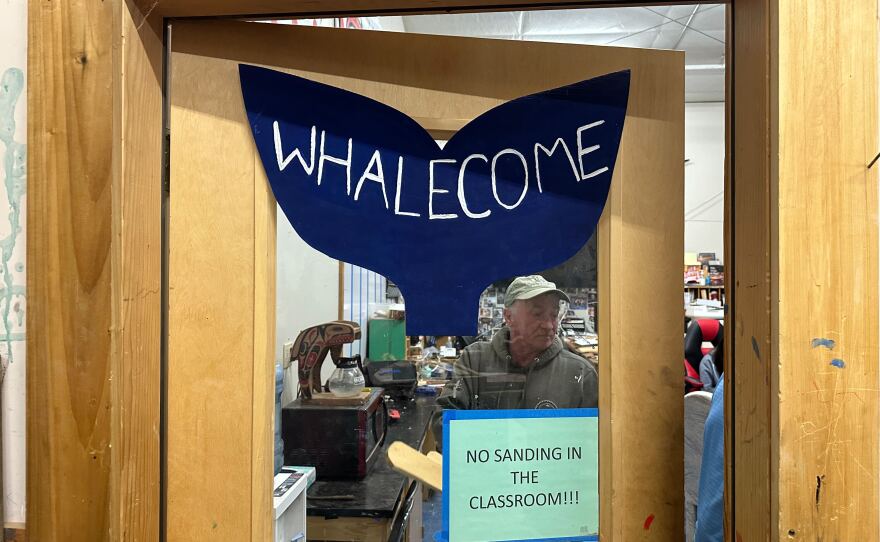
In the woodshop at Neah Bay High School, students chip away at pieces of yellow cedar that they are carving into hollowed out trays. Traditionally, these would be used for dipping whale and seal oil.
Instructor Paul Greene Sr. said this advanced class also makes clubs for fishing and seal hunting. And there is a small group of kids who love to carve paddles for canoes.
“The paddles are a big hit — functional paddles, hard to come by these days, but here we have kids creating them every week,” Greene Sr. said.
Canoes for both racing and whaling are stowed all around the shop — even hanging from the ceiling. One red and black canoe is 32 feet long.
“My students are going to patch it, repair it, and someday it will probably go whaling,” Greene Sr. said.

Working on the canoes fits in well with the cultural teachings that are integrated into most of the classes at the school, Greene said, especially the annual Treaty Day teachings in January, when they learn about the 1855 Treaty of Neah Bay and the last whale hunt in 1999. But students are reminded of Makah traditions all year long.
In a science classroom, an advanced cohort had just wrapped up a unit in which they spent two days rendering bear fat, then made it into soaps and salves. The teacher said prior classes have used whale and seal oil as well.
Across the way, in language class, students practiced their Indigenous Makah language by singing. Seated in a semicircle at desks or on carpeted steps, the teenagers hunkered down in their hoodies and took turns drumming along. On this day, they were practicing a song that is often shared at big celebrations and public presentations, like Makah Days. It’s called "The Whale Towing Song,” which Makah language and culture teacher Hazel Greene explained is meant to be used when towing a whale ashore.
“After whalers would get a whale, it would be a time where songs would come to them, a time for prayer and a time for giving thanks,” she said.
She said for her students, it is a reminder of the importance of whaling, at the very heart of Makah culture, and the reason why Makah leaders made sure to reserve these rights in the 1855 Treaty of Neah Bay.
“These are rights that we're born with. You are born Makah. We have these rights we're fighting for. We're currently fighting for those rights, and when we finally can, we'll just be restoring what is rightfully ours,” she said.

Makah Treaty in the spotlight
Hazel's son, Paul Greene Jr., is a paraeducator for language and helps sing the songs at the school. He also traveled with a delegation in January to perform at the Smithsonian’s National Museum of the American Indian when the agreement signed in Neah Bay was installed in a rotating exhibit of treaties.
Theirs is the only treaty between a tribe and the United States that explicitly promises the right to hunt whales.
Paul Greene Jr. said he hopes the display might tip the scales in their favor as they wait for a whaling permit. He said it’s not a trophy hunt.
“It's a way of life for us,” he said. “It's not with any intention of just killing for fun. It's taking a life and honoring it in the best way that we know how.”
The tribe invited representatives of the U.S. Department of Commerce to their treaty ceremony at the museum in Washington, D.C., because right now, they say, the decision about their whale hunt is in the hands of Commerce Secretary Howard Lutnick. The department did not respond to requests for comment, but media reports going back to the early months of the second Trump administration last year describe a backlog of contracts with the National Oceanic and Atmospheric Administration piled up on Lutnick’s desk. NOAA agreements for weather forecasting, marine fisheries and coastal management — and the Makahs’ whaling permit — all remain in limbo.
Luna Reyna contributed reporting from Underscore Native News + ICT.


