
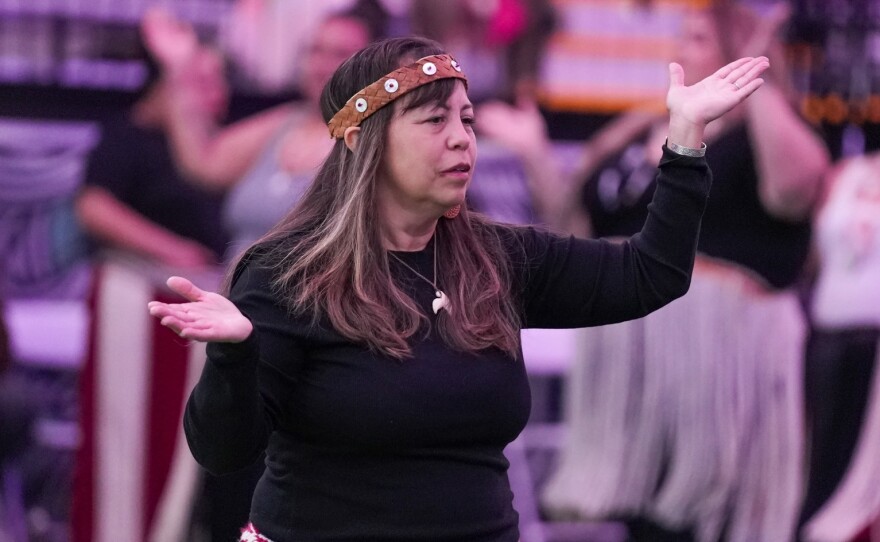




Food trucks selling hot fry bread, burgers and tacos are lined up in neat rows, across from stands of metal bleachers, surrounding a giant outdoor screen. The booming broadcast of a match from the 2026 FIFA Men's World Cup echoes throughout this watch party for the game, hosted by the Puyallup Tribe of Indians.
While Seattle hosts six matches for the World Cup, the Puyallup Tribe of Indians is playing a big role, as an official host city supporter for the games. This is the first time an Indigenous nation in the U.S. has had these responsibilities.
" It's a historic moment," said Amy McFarland, who is directing World Cup events for the Puyallup Tribe. "One of the things that we have, very serious in our culture, we call witness. So we will be calling all of our youth and our adults — yourself included — be witness to this time and event in history."
The tribe has been hosting watch parties, as well as culturally significant gatherings, such as a Coastal Protocol and World Cup Powwow.
Protocol is a traditional cultural exchange of song, dance, and often gift-giving among Indigenous nations, and Coastal Protocol is shared among the Coast Salish people during canoe journeys.
The Puyallup Tribe invited Indigenous nations from around the Pacific Northwest, including up into Canada, to share their songs and dances during Coastal Protocol. The public was invited to watch.
Chay Squally, a member of the Nisqually Tribe, said the Nisqually canoe family joined. Squally said she thinks it's cool how the tribes are engaging with the World Cup while it's in Seattle.
"Everybody is doing their part to show that we have a culture. We have an identity here in Washington State," Squally said. "And so for all those people to come and visit our state, they get to see our rich culture and our people."
McFarland said the World Cup events will have a lasting impact on the Puyallup Tribe. She also hopes their participation will educate people visiting from near and far about who the Puyallup Tribe is.
"That's the opportunity really, the winning point, is to share our culture, our language and our heritage with the world," McFarland said.
Beyond the events, there are other ways the Puyallup Tribe has had an influence on how the games are being presented in Seattle.
When people arrive at SEA-TAC international airport, drive through the streets of Tacoma or watch a game in Seattle, they'll see and hear the Lushootseed language of the Coast Salish peoples.
" That revitalization of language is heartfelt. It runs deep, and it's based off of a lot of hard work," McFarland said.
A video also plays before each of the games in Seattle that features the Muckleshoot, Suquamish, and Puyallup tribes in an acknowledgement of whose land the games are being played on.
Leo Flor is on the Seattle FIFA World Cup 26 Local Organizing Committee (SeattleFWC26). It is a local group distinct from FIFA and handles happenings for the World Cup outside of the stadium.
"It's just really fitting and it makes a ton of sense that in the world's largest and most watched sporting event, that really celebrates the coming together of nations, that we would intentionally include the sovereign Indigenous nations that are hosting it," Flor said.
SeattleFWC26 helped build school soccer pitches for the Puyallup Tribe and the Lummi Nation — to support young Indigenous soccer players.
In Seattle's Pioneer Square, the local organizing committee has commissioned and displayed an art piece for every team's country.
"In every single one of those art pieces is a little sprig or two or three of cedar," McFarland said, "and the cedar is intentionally to represent the Puyallup Tribe."
For Teddy Simchen, another Puyallup Tribe elder, the renewal and acknowledgement of his culture is a change he's witnessed over his lifetime. And this moment is a big one.
"This has put the Puyallup Tribe on the world stage. Now our name's gonna be out there," Simchen said.
Simchen says there was a time when the tribe was nearly assimilated into the metro area. But now, the tribe has thousands of enrolled members. The Puyallup Tribe owns a number of businesses, including a chocolate company, waterfront restaurant and golf course.
"This is what we have strived for my whole life, is to see this happening, and now it's coming to fruit," Simchen said. "I can't be more blessed to be a tribal member, and know that our language and our culture, everything is getting revived the way it should be."
Copyright 2026 NWPB News (Northwest Public Broadcasting)


